DIALYSIS
————-
10yr olds even know about ‘dialysis’ nowadays.Somebody in their household or neighbourhood must be undergoing this treatment which has become so common and so handy to sustain prolonged life for kidney failure patients.Before the advent of dialysis and kidney transplant,kidney failure led to death for sure.Nephrology (science related to kidney related problems)service including dialysis facilities are available in all major private and govt hospitals.There are independent dialysis centres also.Dialysis team can help in home dialysis.Many hospitals offer charity services to deserving patients.
When we consume food and drinks,our body uses what is needed and the rest is turned into waste products and excreted as urine by our healthy kidneys.They also help in production of red blood cells and prevention of anemia .They activate vitamin D to maintain calcium levels and bone health.They regulate blood pressure.They maintain body’s fluid balance.Chemicals like potassium,sodium and bicarbonate are kept in safe levels by them.When kidneys fail to work waste products accumulate in our blood and cause all complications leading to death finally.
Dialysis creates an ‘artificial kidney’ in a patient whose kidneys have lost 85 to 90% function.His GFR(Glomerular Filtration Rate)which should have been 90%or more, is less than 15. (Glomeruli are units inside the kidneys which filter out waste from blood).
GFR is a calculation from the results of the patient’s blood creatinine test,age,weight and gender.
GFR is an unfamiliar word but ‘creatinine’ is nowadays as famous as ‘cholesterol’.The first ‘c’ has overtaken the second ‘c’ actually!!
But what’s creatinine?How’s it connected with kidney function?
Our muscles contain a product called creatine phosphate.Creatinine is produced from this creatine phosphate.It is a waste which is removed from our blood by kidneys regularly.If kidneys fail,creatinine level in blood gets elevated.
Normal creatinine levels are 0.6 to 1.2 milligrams per decilitre in males and 0.5 to 1.1 in females.As age increases the level goes a bit higher.In obese persons also it is seen slightly high though kidneys function normally.
Significant amounts of blood and ‘albumin’ are let out in urine by damaged kidneys.This can be detected by a simple urine test.
Various scans of the kidneys are suggested by the Nephrologists.A biopsy may be taken.These tests show if the kidneys are bigger or smaller,and if there are stones,infections and cancer.They also show the extent of damage that has happened to the kidneys.
A patient with kidney failure can have symptoms like nausea,vomiting,tiredness,giddiness,swelling especially on ankles,less urine,blood pressure variations etc.Sometimes he will not have any symptoms at all.Importance of health check ups has to be emphasised here.
Associated conditions like Diabetes,high blood pressure,liver problems and obesity enhance kidney
failure.Self medications especially with pain medicines can result in kidney damage.
Please get treated by qualified doctors only,not only in Allopathy,but also in Ayurveda,Homeopathy etc.
Kidneys can fail suddenly (acute)as a complication of infections like viral fever,accidents,blood loss,heart and liver diseases,medicines,severe burns,severe allergies,severe dehydration,complicated surgeries,poisoning etc.
Gradual kidney failure(chronic) is due to diabetes,high blood pressure,polycystic kidneys(genetic,can run in families),inflammation of kidneys (nephritis),auto immune diseases(our disease fighting mechanism is affected),improper use of medicines and many unknown causes.
Both acute and chronic kidney failures are dangerous for life.Acute condition needs very prompt treatment,mostly with dialysis but subsides with a few courses usually.Chronic kidney disease needs lifelong treatment ,mostly with dialysis and the Nephrologists may advise kidney transplant.
Dialysis is mainly of 2 types-Peritoneal Dialysis and Hemodialysis.
Peritoneum is a thin membrane that lines the interior of the belly as well as wraps the organs inside it.In ‘peritoneal dialysis’ the peritoneum is made to act as natural filter to remove waste from our body.
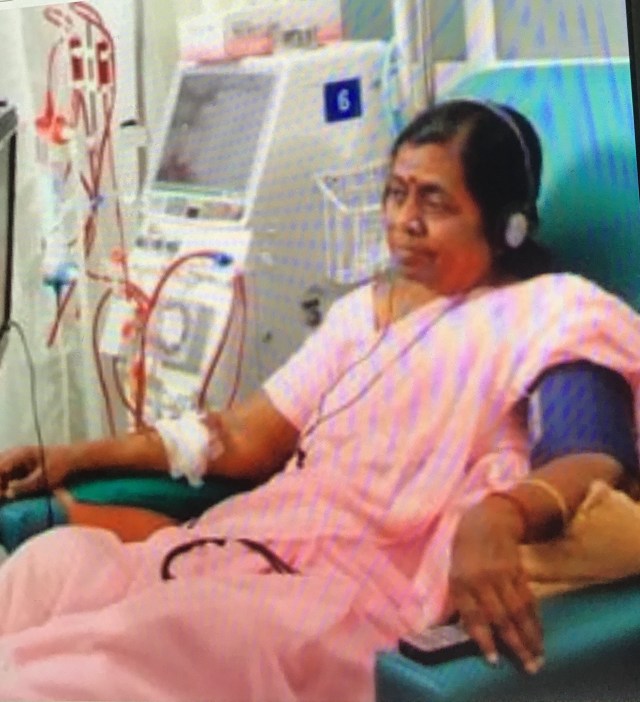
‘Hemo’ means something connected with blood.In hemodialysis a ‘hemodialiser’ is used to remove waste from the patient’s blood .In the arm or leg an artery and a vein are joined together to form a ‘fistula’.Through this portal the dialiser is connected. Sometimes,in emergencies,a neck vein is used for dialysis.
Diet is very important in patients with kidney failure.
No extra salt is added to food.Very salty processed food items do great harm.Less salt is always a kidney-friendly way.
Unused protein from our food is broken down to waste products such as urea and creatinine which are eliminated by our kidneys.If kidneys fail,these wastes accumulate.Eating large amounts of protein food like meat,fish,chicken,eggs and dairy products make matters worse naturally.But once dialysis treatment has started,sufficient proteins will be advised by the doctor whose advice is to be followed strictly.
Phosphate is a mineral found in meat,dairy,nuts and cola.Calcium and phosphate keep our bones,teeth and blood vessels healthy.In cases of kidney failure excess calcium and phosphate accumulate in blood and form hard deposits in heart,lungs,blood vessels,joints etc.Bones also become brittle,painful and break.So such phosphate rich foods are to be cut short as per the doctor’s advice.
Potassium is a mineral good for muscle strength.But high levels affect heart rhythm.In kidney failure if potassium level is to be maintained ,we should avoid bananas,dried fruits,peas,beans,spinach and potato.As said before,once dialysis works in the right way,doctor will advise you about adding these much useful items in your food menu.Tender coconut water too is rich in potassium.
Patients on dialysis should strictly follow fluid restriction advice.This mainly depends on the quantity of urine produced daily.Fluid overload can be dangerous.Dehydration also is harmful.Salt restriction makes one less thirsty.
Dialysis needed or not,which type of dialysis,how many times a week,tests before and after,at home or hospital,diet schedule,activities,treatment of associated diseases,treatment of dialysis-related complications if any ,need for a kidney transplant..all these will be decided by a Nephrologist and his team and discussed with the patient in detail.Every patient is different from every other patient.Possible dialysis-complications are blood pressure variations,muscle cramps,nausea,vomiting,itching,sleep problems,pricking sensation in legs,anemia, bone diseases and fluid overload.
Average life expectancy on dialysis is 5 to 10 yrs but patients have lived upto 30 yrs even.This depends on our other medical conditions.Strict adherence to the Nephrologist’s instructions is extremely important.
 Dr Bhavani Chandrasekharan’s Blog